

IARC Home Page
 
Home > LIMS
LIMS

Context
Over the past 30 years, family-based and association-based studies have enabled identification of susceptibility genes involved in human genetic disorders. For common diseases that have a strong element of inherited risk, an individual's susceptibility is often determined by a complex interaction of multiple genes. Because highly penetrant cancer susceptibility genes that have been identified account for a relative small fraction of the genetic component of cancer risk (15 to 25%) and because studies have failed to identify other highly penetrant cancer susceptibility genes (Thompson and Easton, 2004), it seems likely that the unexplained inherited risk results from interactions of many sequence variants, which individually have modest to moderate effect on attributable cancer risks. Thus, identification of genetic variants that confer susceptibility to cancer (genetic diseases) requires the screening of large numbers of individuals for many possible genetic variations. Advances in genomics technology have steadily increased the level of automation incorporated into laboratory genetics platforms, significantly reducing sample handling time and thereby allowing studies comprising larger numbers of samples. Furthermore, the sequencing of the human genome has, on one hand, markedly contributed to the identification of a large number of single-nucleotide polymorphisms (SNPs) and on the other hand, facilitated the design of new tests for the discovery of new genetic variants. One key challenge in the area of genome research is to manage the large amount of data generated during such genetic screening workflows. There is a need to organise and compute these data in an efficient system that tracks samples, captures data at various steps of the laboratory processes and ensures reliable storage, retrieval and analysis of the data generated.

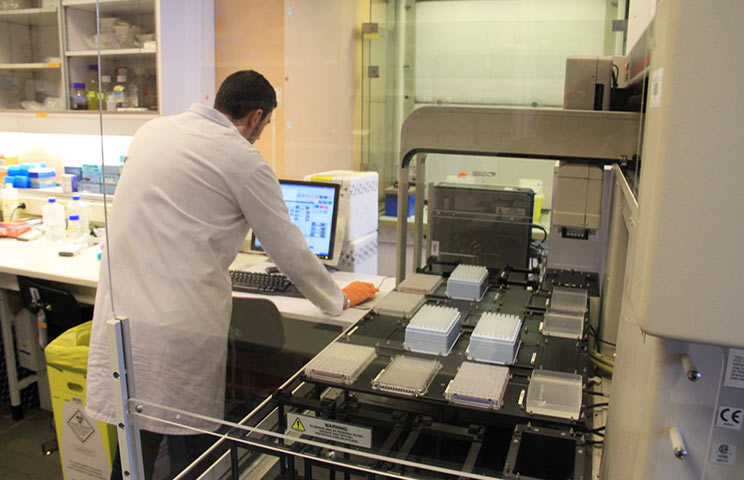
We have therefore developed a platform independent LIMS for a laboratory workflow tailored to the search for new genetic variants in candidate genes. The workflow is based on a combination of a mutation scan by High Resolution Melting Curve Analysis and dye-primer re-sequencing of suggestive samples. The LIMS is based on a Client/Server architecture hosted on two servers, one for a MySQL relational database and one for the web application. Flexible, expansible and highly secure, the LIMS, by communicating with most of the laboratory instruments and robots, tracks every step of our workflow ending with the deposition of processed resequencing data in the database.

Source codes for the different LIMS modules are freely available for the scientific community.
(More information will be provided in the next few weeks or can be provided upon request to 'voegele@iarc.fr')


Download:
LIMS STRUCTURE
 
LIMS architecture
Click here
Servers configuration
Click here
MySQL DATABASE
 
Database model
Click here
Script for database tables creation
Click here
WEB APPLICATION
 
Overview of mutation screening workflow tracked in the LIMS
Click here
Application configuration
Click here
Whole JSP application (zip file)
Click here
Scripts for LIMS communication with the robots and instruments
Click here
Scripts for barcodes printing
Click here
Link to the underlying UBB interface (optional)
Click here


Disclaimer:
Extracts of the information in the web site may be reviewed, reproduced or translated for research or private study but may not be sold or used in conjunction with commercial purposes, and provided any use is subject to an appropriate acknowledgement of the source.
The data and information contained herein are provided on an ''as is'' basis and WHO/IARC makes no representations or warranties, either expressed or implied, as to their accuracy, completeness or suitability for a particular purpose. Similarly, WHO/IARC makes no representations or warranties with regard to the non-infringement of third party proprietary rights. Thus, WHO/IARC does not accept any responsibility or liability with regard to the reliance on, and/or use of, such data and information.


20/06/2007